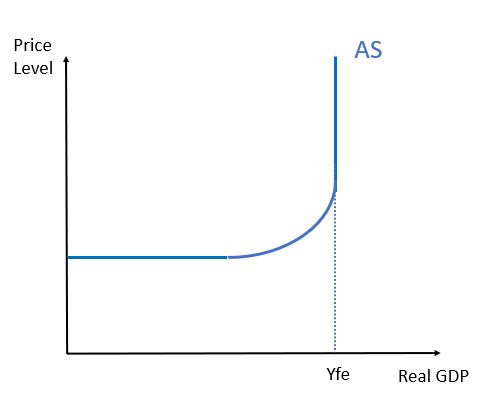
Given the following:
-Country A has Absolute Advantage in Good X.
-Country B has Absolute Advantage in Good Y.
Who has comparative advantage in each good?
-Country A has Comparative Advantage in Good X.
-Country B has Comparative Advantage in Good Y.
(if each country has absolute advantage in exactly one good, it follows that the opportunity cost of producing that good must be lower than that of the other country)
Evaluation of Perfect Competition:
What are the disadvantages of this market structure?
Consumers:
→ Identical products: no choice between products
→ No dynamic efficiency → No innovative products
The Economy:
→ No dynamic efficiency → poor LR (potential) economic growth
Government:
→ No abnormal profit → Lower tax revenues
Workers:
→ No abnormal profit → no fringe benefits
Draw the AVC and MC curves, with care to show what happens at output=1 and when MC = AVC.
A tax where the average tax rate increases as income increases.
Without intervention, a market will produce where Marginal ________ Costs = Marginal ________ Benefits
What are two factors that could shift Demand for Labour to the Left?
-Recession
-Decreased demand for the product the worker produces
How do changes in the prices of substitutes and complementary goods affect demand?
Higher prices of substitutes may decrease demand for a particular product, while lower prices may increase demand. Similarly, changes in the prices of complementary goods can affect the demand for related products.
What temperature does the ocean need to be for a tropical storm to form?
What does constant marginal costs mean?
Firms can increase production and their marginal cost doesn't increase (e.g. Spotify)
Why is LRAS perfectly inelastic?
Production levels in the long run do not depend on price. They only depend on the quality and quantity of factors of production.